
 English

Views: 0 Author: Site Editor Publish Time: 2026-11-13 Origin: Site


Upgrading a mixed agricultural fleet to a unified communication standard presents massive operational stakes. It requires substantial upfront capital investment. You also face inevitable machinery downtime during field deployment. The ISOBUS wire harness serves as the vital physical backbone of modern precision agriculture. It bridges older legacy tractors seamlessly to advanced, high-tech implements. Without reliable physical connections, even the smartest farm management software fails completely. Fleet managers often struggle to separate marketing hype from actual operational capability. This article provides an objective, risk-aware framework for planning your next machinery upgrade. You will learn how to evaluate and select the right connectivity solutions for your specific equipment. We explore compatibility auditing, strict environmental durability standards, and common deployment hazards. Our goal is to equip procurement officers and fleet managers with highly practical insights. You can then make confident purchasing decisions to protect your agricultural operations.
AEF Certification is non-negotiable: Uncertified harnesses risk data dropouts, implement damage, and voided warranties.
Retrofit vs. Extension: Procurement strategies must distinguish between full tractor retrofits and simple implement extensions to avoid overspending.
Environmental Durability dictates ROI: Connector sealing, shielding, and chemical resistance directly impact operational profitability.
Cross-Market Compliance: Standardized ISOBUS compatibility removes technical barriers for fleets operating across varying regional compliance standards (e.g., EU vs. US markets).
Deploying an ISOBUS wire harness successfully breaks restrictive proprietary lock-in. Historically, implement manufacturers utilized completely closed electronic ecosystems. This strategy essentially forced you to purchase matching tractor brands to ensure functionality. Standardized physical connections change this dynamic entirely for modern fleets. You can now easily pull a highly specialized European planter behind a heavy-duty American tractor. This newfound flexibility maximizes your existing asset utilization across all seasons. It effectively prevents premature machinery replacements and optimizes your capital expenditure.
Furthermore, precision farming hardware reliability maps directly to your seasonal yield outcomes. Consistent data flow enables accurate variable rate application in the field. Clean signal transmission ensures auto-section controls fire exactly on schedule. This precision eliminates expensive seed overlaps and reduces chemical fertilizer waste significantly. When hardware communicates without interruption, crop uniformity improves noticeably across varying terrain types.
Finally, standardized connectivity solves major regional compliance headaches. The European Union and the United States maintain varying agricultural machinery regulations. A unified physical ISOBUS layer ensures broad technical interoperability globally. Standardized setups allow massive agricultural enterprises to shift equipment across international borders effortlessly. Fleet managers no longer worry about conflicting regional electronic mismatches disrupting operations during critical planting windows.
Auditing your existing fleet requires systematic and thorough evaluation. You must categorize all tractors by age and specific model year. Next, inspect their current electrical architecture meticulously. You need to determine their baseline CAN bus readiness before purchasing any components. Older machinery models demand different intervention levels compared to newer equipment. Procurement strategies differ greatly based on the results of this initial audit.
Fleet operators typically choose between two main connectivity pathways:
Full Retrofit Kits: Use these specialized kits for legacy tractors lacking modern electronics. They require the installation of In-Cab (INC) terminals. You must wire dedicated power relays directly to the battery. They also require mounting rear Breakaway Connectors (IBBC) on the chassis.
Extension Harnesses and Adapters: Use these simpler cables for modern, pre-equipped machinery. They extend the physical reach between the tractor cab and oversized implements. You need them frequently when operating massive air carts or wide folding planters.
Cross-referencing component compatibility prevents expensive procurement mistakes. Always leverage the Agricultural Industry Electronics Foundation (AEF) database extensively. Check your intended ISOBUS wire harness against specific terminal and implement pairings. Perform this vital check before finalizing any bulk hardware purchase. The AEF database verifies true cross-brand interoperability accurately. It removes dangerous guesswork from the integration process entirely.
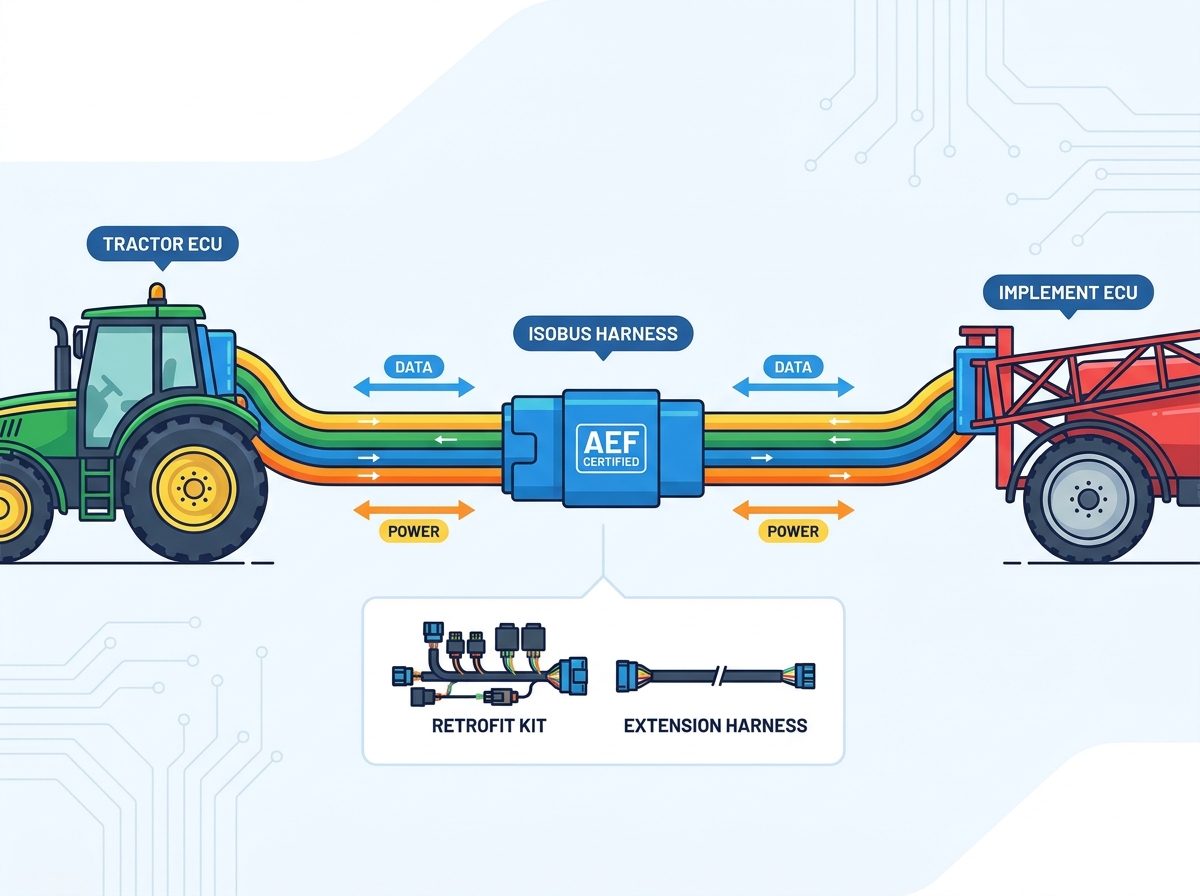
Evaluating connectivity hardware demands strict technical criteria and careful scrutiny. You cannot rely on simple visual inspections or basic manufacturer claims. Let us examine the core dimensions defining premium agricultural networking cables. Data integrity serves as the absolute top priority for any precision operation. Manufacturers must construct cables using tightly twisted-pair wiring configurations. They must apply robust electromagnetic interference (EMI) shielding inside the jacket. Unshielded tractor alternators generate heavy EMI constantly. This interference causes severe CAN bus communication errors instantly. It forces critical signals to drop at the worst possible planting moments.
Physical durability dictates the operational lifespan of your investment. You need serious ingress protection ratings for all external equipment. Plugs and receptacles must carry an IP67 or IP69K official rating. High ratings prevent moisture intrusion during aggressive high-pressure chemical washing. The outer cabling jacket must resist harsh daily UV exposure. It must withstand highly corrosive synthetic fertilizers and potent liquid ammonia. Leaking hydraulic fluids and severe field vibrations destroy inferior cables rapidly.
Power handling capacity also matters immensely during continuous field operations. Review the specific gauge of the internal power and ground wires. High-draw ECU implements require massive continuous electrical current. Thin, substandard wires cause dangerous voltage drops over long distances. Voltage drops force implement controllers to reboot randomly during field passes.
Finally, demand a true plug-and-play architecture from your chosen supplier. Look for OEM-grade connectors like Deutsch or Amphenol consistently. These premium components eliminate risky manual field-splicing entirely. They guarantee secure, weather-tight connections every single time you hitch an implement.
Evaluation Metric | Minimum Recommended Standard | Operational Benefit |
|---|---|---|
Data Integrity | Twisted-pair wiring, full EMI shielding | Prevents CAN bus data dropouts near alternators |
Ingress Protection | IP67 or IP69K rated connectors | Survives pressure washing and heavy rain storms |
Power Handling | Heavy gauge (e.g., 8-10 AWG for primary power) | Eliminates voltage drops to high-draw ECUs |
Connection Type | OEM-grade (Deutsch/Amphenol) | Removes the need for vulnerable wire splicing |
Deploying new networking hardware across an aging fleet introduces distinct physical risks. Routing hazards pose the most immediate threat to cable longevity. Technicians must avoid obvious metal pinch points during the installation phase. They must route delicate communication lines far away from exhaust manifolds. Moving articulation joints often crush improperly secured cables instantly. You need strict, standardized routing protocols for your maintenance team.
Follow these mandatory routing steps to protect your equipment:
Map the entire intended cable path before securing any plastic zip ties.
Leave adequate loop slack near the three-point hitch for full mobility.
Install tough protective looming wherever the cable touches bare metal edges.
Secure the mainline every twelve inches to prevent destructive vibration wear.
Voltage drops plague excessively long extension runs consistently. Massive folding planters or large air carts require extended connectivity cables. Excessive physical length causes severe electrical signal degradation naturally. Insufficient electrical power reaches the rear implement controllers as a result. You must calculate total power requirements carefully before extending any network.
Diagnostic challenges also frustrate maintenance teams frequently in the field. Avoid networking products lacking easily accessible diagnostic testing ports. When CAN bus communication errors occur, mechanics need quick multimeter access. Hidden or entirely missing diagnostic ports complicate field maintenance drastically.
You must factor in downtime risks during the initial installation period. Fleet-wide retrofitting carries a notoriously steep learning curve for technicians. Schedule your major technological upgrades during off-season maintenance windows exclusively. This strategy minimizes the financial impact of unexpected integration delays.
Choosing the right hardware supplier protects your capital investment long-term. Not all manufacturers build communication cables to identical engineering standards. You need a reliable, strict procurement checklist to vet vendors. First, verify all claimed technical standards completely transparently. Does the manufacturer provide clear, documented proof of ISO 11783 compliance? Do they show verifiable, up-to-date AEF certification? Reject suppliers immediately if they hide or delay providing this documentation.
Evaluate their warranty offerings and technical support structures critically. Analyze the official return policy closely before signing any purchase orders. Check the exact warranty duration for commercial fleet applications. Ensure they offer accessible, native-speaking technical support during your working hours. Troubleshooting complex integration issues requires seasoned expert guidance. You will need their direct help when unexpected software glitches occur.
Scalability separates true manufacturing partners from basic hardware vendors. Can the supplier fulfill bulk fleet orders reliably before planting season? Do they offer diverse cable lengths and pin configurations? Your agricultural fleet features incredibly diverse implement requirements. You need a responsive supplier capable of covering every single machine variation.
Finally, demand entirely transparent costing structures upfront. Watch out carefully for hidden supplementary hardware costs. Some suppliers require expensive proprietary adapters to achieve basic functionality. Others force you to buy restricted proprietary diagnostic tools. A quality ISOBUS wire harness should integrate seamlessly without triggering forced upcharges.
Upgrading your machinery networking requires strict adherence to industry standards. Always prioritize AEF-certified components above all other purchasing criteria. Match the specific cable type accurately to your initial fleet audit. Prioritize extreme physical durability to survive harsh agricultural environments. Follow precise routing guidelines to extend the lifespan of your field connections significantly.
Your safest action plan involves starting small and scaling thoughtfully.
Conduct a controlled pilot installation on a single tractor-implement pairing first.
Validate the communication stability in real, demanding field conditions.
Document any unexpected installation hurdles or missing terminal adapters.
Train your machine operators thoroughly on the new cab interface.
Roll out the technological upgrade fleet-wide only after completing a successful pilot.
A: Retrofits build the core communication network on a legacy tractor. They include specialized cab terminals, heavy-duty power relays, and rear implement connectors. Extensions merely lengthen the physical connection between a modern, pre-equipped tractor and a massive implement.
A: Certification guarantees the component passed rigorous independent testing for ISO 11783 compliance. This strict verification ensures seamless cross-brand interoperability. It effectively prevents debilitating software conflicts when you mix different equipment brands in the field.
A: Most post-1990s tractors operating a standard 12V electrical system can accept network retrofits. However, installation complexity varies significantly based on the existing cab layout, battery access, and alternator capacity.
A: OEM-grade networking harnesses should easily match the operational lifecycle of the implement itself. Proper IP ratings and safe routing techniques maximize this lifespan. Severe physical field damage remains the primary cause of early equipment failure.


