
 English

Views: 0 Author: Site Editor Publish Time: 2026-11-01 Origin: Site


Transitioning agricultural and heavy-duty equipment to the ISO 11783 standard is no longer optional for modern interoperability. High-tech farming demands seamless communication between tractors and implements. However, procuring the necessary infrastructure requires balancing upfront capital with long-term reliability.
Procurement and engineering teams often struggle to isolate the true costs of these components. You must weigh raw materials against compliance testing, tooling, and environmental durability requirements. Miscalculating these variables can severely impact project budgets and timeline deliverables.
This article provides a transparent, line-item breakdown of core cost drivers. We compare custom versus standard configurations to clarify your procurement options. You will also learn concrete strategies for value engineering your supply chain without sacrificing field performance.
Material vs. Engineering Costs: Physical components (connectors, shielded twisted pair cables) typically account for 40-50% of the cost, while compliance testing and custom tooling drive the remainder.
Compliance is a Cost Driver: Meeting AEF (Agricultural Industry Electronics Foundation) and ISO 11783 standards requires rigorous shielding and termination, which raises unit costs but eliminates field compatibility failures.
Strategic Sourcing Saves Margins: Applying VAVE (Value Analysis and Value Engineering) early in the design phase can reduce per-unit costs by up to 15-20% at scale.
Standard vs. Custom: Low-volume fleet upgrades benefit from standard OEM parts, while implement manufacturers require custom architectures to optimize unit economics.
When you analyze an ISOBUS wire harness, raw materials and labor form the largest initial expenses. Understanding these elements helps you identify where your budget goes. It also highlights areas where you can optimize specifications.
Raw cables dictate both performance and baseline pricing. Engineers must select specific wire types to ensure uninterrupted communication across the implement.
Shielded Twisted Pairs: You need specialized CAN bus cabling for robust data transmission. High-EMI (electromagnetic interference) environments demand these shielded lines. Agricultural machinery generates massive electrical noise. Unshielded cables will suffer data loss and communication errors.
Jacket Materials: Your choice of outer insulation directly impacts durability and cost. Pricing varies significantly between standard PVC, Polyurethane (PUR), and cross-linked elastomers.
Table 1: Cable Jacket Material Comparison
Material Type | Relative Cost | UV & Chemical Resistance | Best Use Case |
|---|---|---|---|
Polyvinyl Chloride (PVC) | Low | Moderate | Cab interiors or protected routing. |
Polyurethane (PUR) | Medium | High | Exposed implement sections prone to abrasion. |
Cross-Linked Elastomer | High | Extreme | Severe environments facing constant chemical exposure. |
Common Mistake: Choosing standard PVC for external routing to save money. Fertilizers and UV exposure will degrade the jacket rapidly, leading to expensive field failures.
Hardware selection serves as a massive cost multiplier. Agricultural electronics demand ruggedized, weatherproof connection points.
Industry-standard 9-pin breakaway connectors are mandatory for ISOBUS conformity. Brands like Deutsch, TE Connectivity, and Amphenol manufacture these specific interfaces. Their proprietary designs carry a premium price tag. You cannot substitute them with generic automotive connectors.
You also must choose between potted and overmolded connectors. Potted connectors use liquid resin poured into a shell. They cost less for low-volume production but offer varying reliability. Overmolded connectors inject molten plastic around the connection. They provide superior IP67/IP69K environmental sealing. Overmolding requires expensive steel molds, making it cost-effective only for high-volume orders.
Assembly methods dictate a significant portion of unit pricing. Simple point-to-point cables easily accommodate automated stripping and crimping. This automation drives labor costs down.
Complex, multi-branch harness architectures require manual assembly on layout boards. Technicians must route, tape, and inspect each branch by hand. Adding specialized terminating resistors complicates the process. Integrating active ECUs (Electronic Control Units) directly into the assembly further increases labor hours and quality assurance testing time.
Deciding between OEM replacements and custom engineering shapes your procurement strategy. Each path offers distinct financial benefits depending on your operational scale.
Standardized harnesses offer immediate availability. Dealerships and fleet managers retrofitting existing machinery rely on these parts. You can quickly integrate them into John Deere, AGCO, or similar equipment.
The cost profile heavily favors low-volume buyers. You pay a higher per-unit price, but you face zero NRE (Non-Recurring Engineering) expenses. You avoid all tooling and design fees. If your fleet requires immediate upgrades, off-the-shelf solutions prevent costly machinery downtime.
Shortline equipment manufacturers building new smart implements usually require custom architectures. Off-the-shelf lengths rarely fit specialized chassis routing perfectly.
Custom builds carry a steep initial financial barrier. You must cover high NRE costs for design, prototyping, and injection molding tooling. However, you achieve a significantly lower per-unit cost at production volumes.
Chart 1: Standard vs. Custom Breakeven Matrix
Production Volume | Off-the-Shelf Unit Cost | Custom Amortized Unit Cost | Recommendation |
|---|---|---|---|
1 - 50 Units | $250 | $1,500+ (High NRE impact) | Choose Off-the-Shelf |
50 - 200 Units | $250 | $350 | Choose Off-the-Shelf |
500+ Units | $230 (Bulk discount) | $150 (Tooling amortized) | Choose Custom |
Assessing overall project economics requires examining expected annual volume. You must also factor in the design lifecycle and required IP ratings. If you plan to manufacture an implement for five years, amortizing custom tooling costs makes financial sense. If you only need a temporary retrofit, stick to standardized parts.
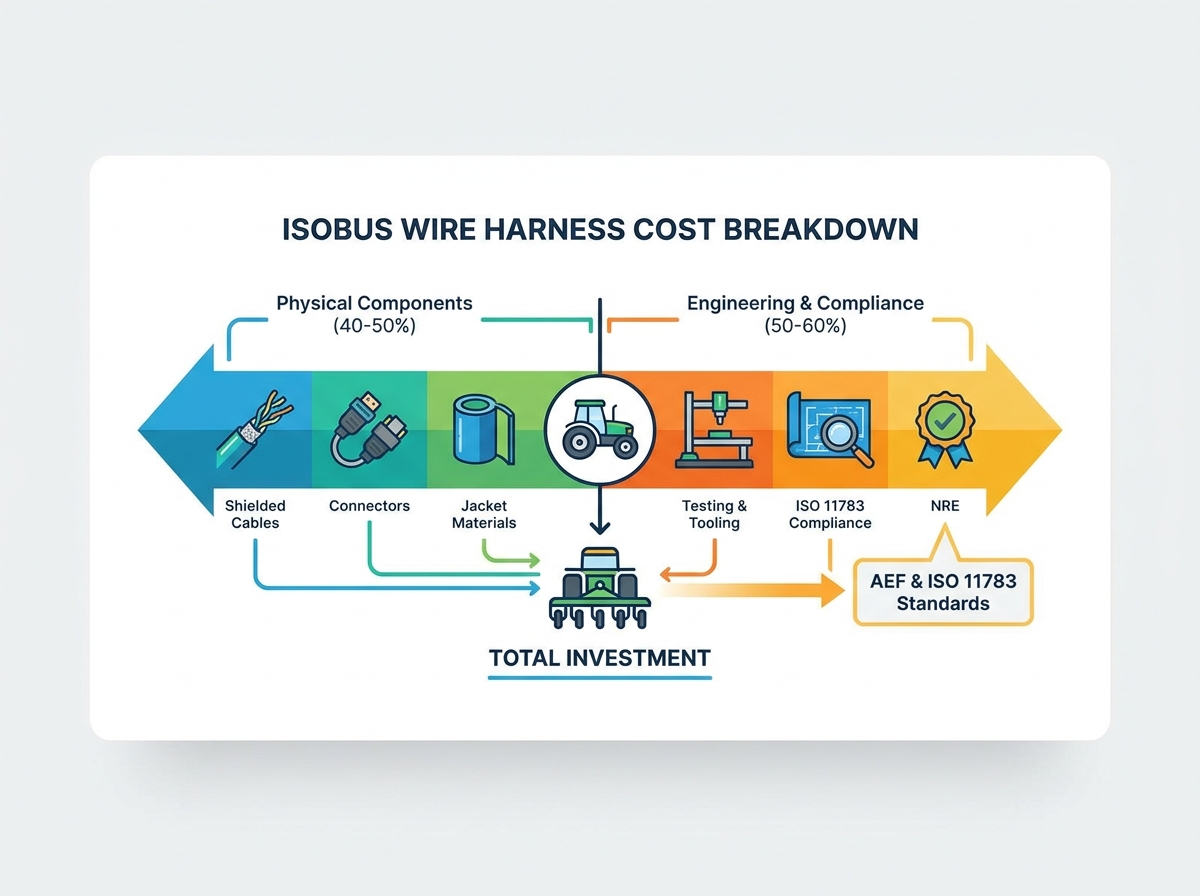
Initial quotes rarely reflect the final deployment cost. Engineering teams must budget for rigorous testing and supply chain realities. Ignoring these hidden expenses often disrupts production schedules.
Seamless cross-brand interoperability does not happen by accident. Manufacturers must verify signal integrity, voltage drop limits, and proper network termination.
Testing requires specialized equipment and engineering hours. Skipping preliminary compliance testing creates enormous financial risk. If your equipment fails AEF database certification, you cannot market it as ISOBUS compatible. Fixing physical layer issues post-production requires expensive harness redesigns and recalls.
Best Practice: Perform physical layer pre-compliance testing early in the prototype phase. Verifying voltage drops and CAN bus impedance limits prevents costly tooling modifications later.
Agricultural environments destroy fragile electronics. You must budget for accelerated life testing to validate your designs. Facilities subject harnesses to aggressive vibration profiles matching tractor frequencies. Thermal cycling exposes materials to rapid freezing and baking. Ingress protection verification ensures water and dust cannot penetrate the connectors during high-pressure washdowns. Outsourcing these tests to certified third-party laboratories adds thousands of dollars to initial development budgets.
Specialized ISOBUS connectors and communication chips frequently suffer from global shortages. Long lead times force manufacturers into difficult financial positions. You may need to purchase massive safety stocks to keep assembly lines moving. Holding these components ties up operating capital. You must factor these inventory carrying costs into your overall procurement budget.
Reducing costs does not mean sacrificing durability. Smart engineering and strategic sourcing allow you to protect your margins while delivering robust agricultural technology.
Collaborating with harness manufacturers during the CAD routing phase yields massive savings. Mechanical engineers often design physical wire routes without consulting electrical teams. This isolation creates inefficient paths.
Involving your supplier early helps optimize branch lengths. They can identify ways to minimize material waste. Shortening cable runs also reduces voltage drop issues, saving you from upgrading to thicker, more expensive copper gauges.
VAVE methodologies systematically eliminate unnecessary costs. Engineering teams should review every connection point.
Standardize Connector Families: Avoid using five different connector brands across one machine. Standardizing on a single family (like Deutsch DT series) leverages volume purchasing power.
Consolidate Splices: Every splice requires cutting, crimping, sealing, and taping. Streamlining physical routing reduces splice counts. This consolidation significantly cuts manual assembly labor.
Optimize Pin Configurations: Remove unused wires from the design. Even short runs of unnecessary copper add up over thousands of units.
Commodity market volatility directly impacts cable pricing. Copper and resin prices fluctuate daily. You can insulate your build costs by negotiating blanket orders.
Safety stock agreements allow suppliers to buy raw materials in bulk when prices dip. Accurate volume forecasting enables your contract manufacturer to schedule automated machinery efficiently. Sharing a reliable 12-month rolling forecast guarantees better pricing than submitting sporadic, rush orders.
Upgrading machinery requires capital, but the return on investment justifies the expense. Modern farming relies heavily on data. Standardizing your equipment creates immediate value for both manufacturers and end-users.
Legacy systems required farmers to install a specific monitor for every implement. Tractor cabs became cluttered with proprietary screens and tangled wires. ISOBUS eliminates this chaos.
A single virtual terminal (VT) can control multiple implements. This standardization reduces auxiliary hardware costs for the end-user. Operators enjoy a cleaner cab and a unified interface, which heavily influences their purchasing decisions.
Plug-and-play standardization drastically reduces assembly line time for OEMs. Workers simply connect standardized 9-pin interfaces rather than manually wiring proprietary controllers.
Diagnostics become much simpler. Technicians can read standardized error codes across the CAN bus network. This transparency lowers warranty claims related to faulty field wiring. Dealerships spend less time troubleshooting interoperability issues, protecting your brand reputation.
Equipping implements with a certified network increases your Total Addressable Market (TAM). Farmers rarely run single-color fleets. They might own a John Deere tractor, a Kinze planter, and an AGCO sprayer.
If your implement features a certified connection, it becomes instantly compatible with mixed-color fleets. You no longer restrict your sales to a specific tractor brand. This universal compatibility serves as a powerful marketing tool that accelerates sales cycles.
Investing in standardized wiring architectures secures your machinery's future. Specialized shielding and robust connectors undeniably raise initial production costs. However, they mitigate devastating field downtime and frustrating interoperability failures.
Evaluate your volume needs carefully. Fleet operators should prioritize rugged, off-the-shelf harnesses for immediate deployment. Implement manufacturers must seek contract manufacturers capable of deep VAVE execution and ISO 11783 compliance testing.
Take action today by auditing your current machinery’s communication failures. Project your annual harness volume for the next two years. Then, consult a specialized agricultural wire harness manufacturer for an accurate NRE and per-unit cost estimate.
A: Prices vary widely based on length, branch complexity, and volume—typically ranging from $150 to $600+ per unit at production scale, excluding initial engineering and tooling costs.
A: Yes, for custom designs. NRE covers blueprinting, specialized connector tooling, and compliance testing prototypes. These are one-time costs offset by volume production.
A: While the physical harness itself isn't standalone-certified by AEF, it must precisely meet ISO 11783 physical layer specifications (voltage, impedance, shielding) for the equipment as a whole to pass certification and operate smoothly on a certified network.
A: No. Standard automotive harnesses lack the necessary twisted-pair shielding, specific terminating resistors, and ruggedized 9-pin breakaway connectors required for tractor-to-implement data networks.


