
 English

Views: 0 Author: Site Editor Publish Time: 2026-11-27 Origin: Site


In precision agriculture, data flows only as reliably as the physical connection carrying it. A compromised connection between tractor and implement means immediate downtime, degraded variable-rate applications, or total loss of implement control. While the ISO 11783 standard guarantees universal software language, the physical hardware executing it varies wildly in quality, durability, and application. Farm managers often discover this vulnerability during critical operational windows. Evaluating an ISOBUS wire harness requires moving beyond basic compatibility. You must look closely at build quality, environmental resilience, and implementation reality. We must navigate varying specifications to protect operational timelines. Here is an evidence-based framework for selecting the right solution for your fleet.
Not All Hardware is Certified: AEF (Agricultural Industry Electronics Foundation) certification is the baseline for ensuring a harness meets strict ISO 11783 electrical standards; non-certified variants pose severe CAN bus failure risks.
Categorize by Need: Solutions break down strictly into OEM replacements, aftermarket retrofits (for legacy machines), and application-specific extensions.
Durability Trumps Price: Operating environments dictate that IP67/IP69K ratings and corrosion-resistant pin plating are non-negotiable for long-term ROI.
Length Impacts Signal: Physical wire lengths and gauge directly influence voltage drops and terminating resistor requirements.
Every decision around network hardware should focus on operational downtime. A failed cable during a tight planting window halts fieldwork entirely. You lose valuable hours troubleshooting electrical faults. The premium paid for a high-tier cable is negligible compared to lost crop yield. Uncertified components often fail when you need them most. Protecting your network infrastructure ensures your machines keep moving.
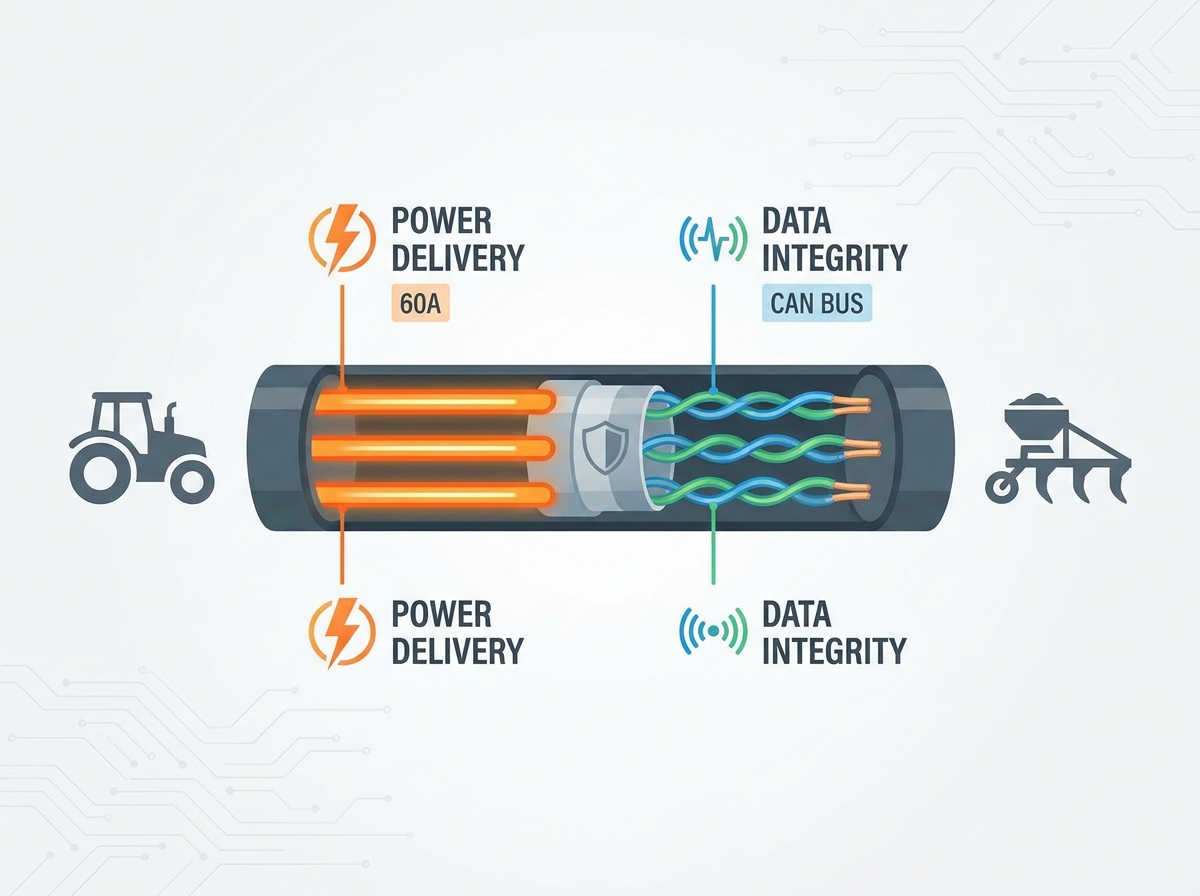
You must balance data integrity against power delivery. An ISOBUS wire harness carries a massive dual burden. It handles high-amperage power delivery for implement electronic control units (ECUs). Simultaneously, it transmits highly sensitive CAN bus data signals. Poorly constructed cables suffer from cross-interference. High electrical loads can corrupt data packets if shielding is inadequate. This corruption leads to erratic implement behavior or total system lockups.
Industry marketing heavily promotes standardization. Many operators falsely assume ISOBUS is completely plug-and-play. The software protocol itself is indeed strictly standardized. However, the physical implementation varies drastically among manufacturers. Routing designs, connector housing materials, and strain relief mechanics differ greatly. Most system failures occur at these physical weak points rather than within software logic. Recognizing this reality helps you avoid costly purchasing mistakes.
Understanding the available hardware categories simplifies the selection process. We classify these solutions strictly by their intended operational use case.
Solution Category | Primary Use Case | Core Advantage | Potential Drawback |
|---|---|---|---|
OEM Factory Replacement | Replacing damaged original equipment | Guaranteed diagnostic integration | High price and long lead times |
Aftermarket Retrofit Kit | Upgrading legacy non-ISOBUS tractors | Modernizes older fleets effectively | Requires careful power specification |
Extension & Adapter | Bridging gaps for large implements | Enables diverse fleet connectivity | Increases signal loss risk |
Original Equipment Manufacturer (OEM) solutions offer immense peace of mind. They provide guaranteed fitment for your specific tractor model. Mechanics appreciate the native integration. These factory cables preserve existing diagnostic capabilities smoothly. They also maintain active machine warranties seamlessly. However, convenience carries a notable penalty. OEM options frequently carry a steep price premium. You also face potential supply chain delays. Lead times can stretch into weeks during busy planting seasons. If your dealer lacks local inventory, you remain grounded.
Many farm managers operate mixed-age fleets. You often need to upgrade legacy tractors. Aftermarket retrofit kits bridge this exact technological gap. They allow older non-ISOBUS tractors to communicate smoothly. You can connect them directly to modern smart implements. Evaluation criteria for retrofits are extremely strict. The kit must include properly specified terminating resistors. It requires dedicated in-cab Universal Terminal (UT) connections. Furthermore, you must verify it includes battery-direct power fusing. Skimping on these features creates dangerous electrical hazards.
Modern farming utilizes massive, complex equipment. Trailing implements like large air seeders require extensive reach. Extension harnesses successfully bridge these long physical gaps. Adapters also serve a critical role. They adapt standard 9-pin setups to proprietary older connectors. Yet, this flexibility introduces unique risk factors. Each new connection point introduces a potential failure vector. Moisture ingress becomes highly likely at every junction. Voltage drop also compounds across multiple connection nodes.
Technology continues to push toward wireless connectivity. Wireless implement control is certainly emerging across agriculture. However, a pragmatic reality check is necessary. Physical hardware remains the ultimate standard for high-liability applications. High-bandwidth applications require absolute stability. Field environments generate intense signal interference. Topography blocks wireless signals unpredictably. Physical connections prevent latency issues entirely. They guarantee immediate execution of crucial safety commands. Until wireless protocols achieve flawless reliability, copper wires rule the field.
Visual inspection alone cannot determine cable reliability. You must evaluate specific technical dimensions before authorizing any purchase.
AEF Certification & ISO 11783 Compliance: This certification serves as the ultimate benchmark. It guarantees absolute trustworthiness across brands. You should always verify products through the public AEF database. Without this official verification, the buyer assumes all compatibility risks. Uncertified equipment often triggers phantom CAN bus errors.
Environmental Sealing (IP Ratings): Agricultural environments destroy weak plastics quickly. Harnesses endure harsh chemical fertilizers daily. High-pressure washing forces water into microscopic gaps. Extreme field dust acts as an abrasive. Look for verifiable IP67 or IP69K ratings. These ratings must apply to all connector boots. IP69K guarantees survival against high-temperature, high-pressure spray.
Pin Integrity & Material: The standard 9-pin connector requires rigorous evaluation. Never accept stamped metal pins for heavy-duty use. Emphasize the need for solid machined pins instead. Machined pins resist bending under mechanical stress. They also require adequate metallic plating. High-quality plating resists oxidation caused by ambient moisture.
Wire Gauge & Shielding: Internal wire construction dictates overall performance. Power pins demand heavy gauge wire construction. You typically need 8 AWG cable to handle loads safely. Implement ECUs draw continuous 60A loads frequently. Undersized wires melt under these extreme demands. Meanwhile, CAN data lines require distinct protection. They need twisted-pair shielding specifically. This shielding prevents electromagnetic interference (EMI) from disrupting data.
Purchasing exceptional hardware only solves half the equation. Physical installation dictates long-term reliability. Certain adoption risks require immediate attention.
Warn your installation team about voltage drop dynamics. Extended runs alter electrical physics significantly. Pushing beyond recommended lengths causes severe problems. Exceeding these limits without gauge upgrades limits power delivery. Implement ECUs experience sudden brownouts during high load. These brownouts force the ECU to reboot mid-operation. Rebooting causes skips in seed placement or chemical application. Always calculate the total line length before purchasing extensions.
CAN bus termination errors remain a common failure point. Data networks require specific boundaries to function. Retrofit applications frequently suffer from poor installation practices. Installers often place terminating resistors improperly. Sometimes they omit the resistors entirely. This mistake causes data signals to bounce back aggressively. Signal reflection leads to erratic terminal behavior. Screens freeze, or implements stop responding entirely. Proper 120-ohm termination is absolutely critical.
Routing determines the ultimate lifespan of the cable. Mechanical strain destroys perfect cables rapidly. Discuss the physical installation plan carefully. Proper breakaway brackets are just as important as the cable itself. They allow the connector to detach safely under extreme tension. Strain-relief routing prevents internal wire breakage. Sharp turns behind the tractor generate immense shearing forces. If you secure cables poorly, they will shear off completely.
Use a structured approach to narrow down your options. Different operational needs dictate specific purchasing paths.
For Legacy Fleet Upgrades: Focus on comprehensive aftermarket retrofit kits first. Prioritize vendors offering direct, responsive technical support. Verify they supply fully AEF-certified components exclusively. Good support saves days of diagnostic frustration.
For Direct Replacements: Compare OEM lead times against certified aftermarket equivalents. Downtime dictates your flexibility here. If you choose an aftermarket option, verify strict specifications. It must meet the exact OEM pinout configuration. It must also match original power delivery metrics perfectly.
For Custom Implement Lengths: Source heavily shielded extension cables primarily. Total line length matters immensely. Keep the total length strictly within ISO 11783 physical layer limits. Staying within limits maintains flawless signal integrity. Exceeding limits requires active signal repeaters.
Audit your current fleet before issuing any purchase orders. Check the existing connector wear carefully. Loose pins indicate an immediate replacement need. Consult your specific implement power draw requirements. Request detailed specification sheets from potential vendors. Note the listed wire gauge and exact IP ratings specifically. Taking these next steps prevents catastrophic field failures.
Selecting an ISOBUS cable solution is an exercise in risk mitigation. The right solution balances up-front cost appropriately. It delivers rugged environmental durability effectively. It also guarantees strict protocol compliance without compromise. Protecting your network infrastructure maximizes your equipment investment.
Avoid generic, uncertified cables at all costs. Treat this hardware as critical network infrastructure. Do not view it as just a simple physical accessory. A reliable connection ensures your precision farming data remains accurate. Data integrity directly influences your seasonal profitability.
Consult your implement’s power draw specifications today. Cross-reference potential harness solutions thoroughly. Use the official AEF certified database to verify claims. Taking these actions ensures seamless integration across your entire fleet.
A: Yes, provided the harness is fully ISO 11783 compliant and AEF certified. However, retrofit installations on older tractors require careful electrical planning. You must ensure the machine's alternator and battery can adequately support the implement's power draw.
A: Manufacturers will explicitly state AEF certification on the official spec sheet. You can also verify specific brands and part families independently. Simply search for the product in the public AEF ISOBUS Database online.
A: The most common causes involve physical strain, like a lack of breakaway brackets. Moisture ingress leading to pin corrosion is another major factor. Degradation of the cable jacket from continuous UV exposure or harsh agricultural chemicals also destroys cables rapidly.
A: Not currently for full implementations. While TIM (Tractor Implement Management) and wireless telemetry are advancing, physical cables remain essential. They are still required to securely deliver high-amperage power and guarantee zero-latency safety commands in the field.


